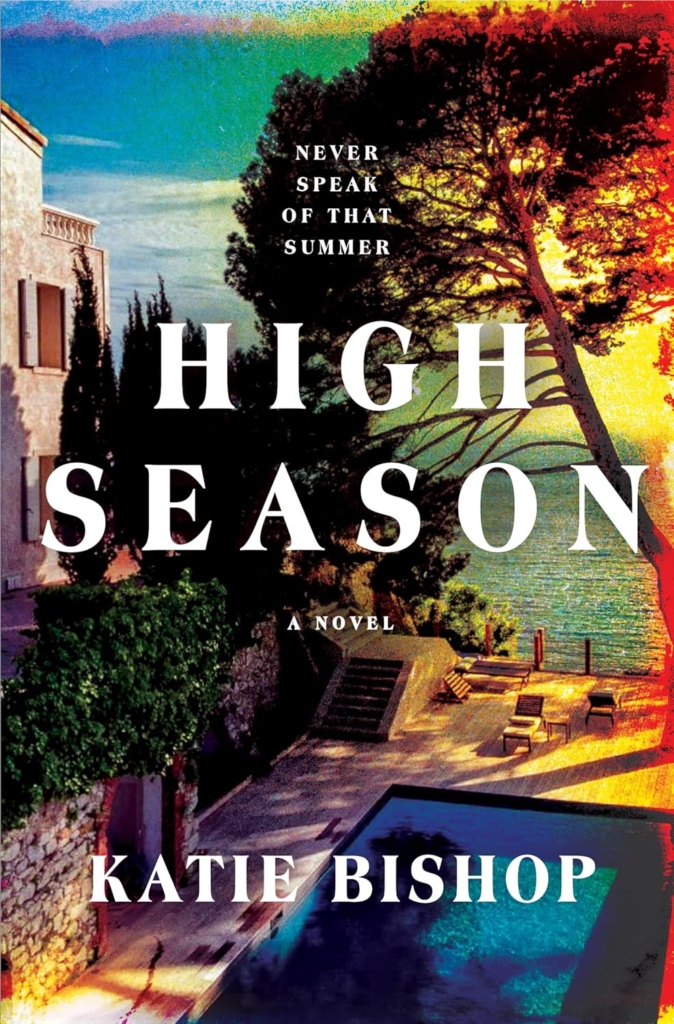
Releasing next Tuesday, High Season is for those of you who are interested in true crime podcasts (this is entirely fictional, but through the podcast and the dual timeline reveals, we find out the true culprit). Set between 2004, when Tamara Drayton drowned in the pool of her family’s home in Côte d’Azur, where Josie, the babysitter, was charged and sent to prison for her murder, and 2024.
The only witness to Josie’s supposed crime was five-year-old Nina Drayton, who no longer has any memory of what happened that night. Now that Nina is an adult, she returns to the family home after receiving an email about the podcast that promises new evidence has been discovered. She is determined to find out who killed her sister, no matter the cost.
Get an inside look at the book before it releases in this Q&A with Author Katie Bishop, and pre-order your copy.

When did you first come up with the storyline for High Season?
The idea for High Season first came a couple of years ago when I was finding that the TikTok algorithm was showing me lots of true crime content. I started to think a lot about what it must be like if your family member or loved one was the victim – or even perpetrator – of a crime that was being discussed online and picked apart by amateur sleuths.
This set me thinking about the morality of the true crime phenomenon. Is it a force for good, or a kind of voyeurism that’s harmful to both those involved and the people creating and consuming the content? While I was mulling this over, I heard about a real-life case where a young child had testified in a murder trial, leading to their mother being convicted of killing their sibling. The mother was still adamant that they hadn’t done anything wrong, and I started to think about how it would feel for the witness ten or twenty years later to know that their testimony had changed the lives of so many people. We remember so little about the early years of our lives. How could you be sure, decades on, that you’d told the truth?
These two ideas came together to form the basis of High Season. What if you were at the center of a murder case that had gone viral online, but you couldn’t be sure that what you’d said was true? How would it feel to be the person whose testimony was being picked apart? What responsibility would you have to find out what really happened?
Do you plot out your book in advance or see where the characters take you?
I like to have some idea what direction the book will go in; otherwise, I tend to find things really challenging further down the line when you hit tricky plot points! But I also like to keep the plan loose – things always tend to change as you get to know your characters, and the book rarely ends up going exactly where I originally thought it would.
What was your most interesting find during the research process, and did you visit the south of France before writing the book?
Before I started writing High Season, I was actually working on another novel, but really struggling with it. I went to the South of France on a mini writing retreat with a friend, and while I was there, it hit me how perfect the setting would be for a novel. The privilege is immense in some parts, but it’s a place of two halves. Often, the richest people are those who don’t live there full-time, but have beautiful holiday homes, and many local people make a living catering to their needs. The claustrophobic heat and the intricate class dynamics were irresistible grounds for a story, and soon I was abandoning the novel that I was previously working on to focus on High Season instead!
Is the Drayton mansion based on a real home in the area?
The Drayton mansion (the pink house) isn’t based on a real home, but I definitely had fun looking at multi-million pound houses online to get an idea of how I wanted it to look!
Setting is so important to me, and I really wanted to build a clear image of the pink house. It was built by ageing socialite Evelyn Drayton’s film-producing father in the fifties, and used to be an incredibly glamorous place where Old Hollywood celebrities would come to party, but over the years, it’s started to crumble and decay. It represents many of the questions of class and privilege in the novel, and I had such a clear image of this incredible mansion built into a cliff-face that’s starting to become so dilapidated that you can imagine it could crumble into the sea at any minute. It all adds to the atmosphere and tension of the story!
Let’s talk about the twist (without giving anything away). Did you know who the culprit was going to be before you started writing the book?
I played with lots of different endings to the book, so it wasn’t set in stone from the beginning. But I like to think of High Season as less of a “whodunnit” than a “how-done-it”. It’s not as simple as finding out who killed Tamara Drayton, but more about peeling back the layers of the summer that she died, and exploring everyone’s secrets. Everyone who was at the pink house that summer has something to hide, whether or not it was about who killed Tamara. Many of those secrets I discovered along the way as I developed the characters and explored their flaws and motivations.
What scene was the most difficult to write?
I always find endings hard. It can be difficult to settle on something that feels satisfying for the reader and delivers on all of the promises and questions you’ve set up throughout the book. I probably wrote four or five different endings to High Season before I settled on one I was happy with!
Out of all of the characters, which character did you feel the most connection to?
I think that there are parts of every female character that I feel connected to, so it’s hard to pick one.
I really related to Nina, the witness to the murder, because of her anxiety and tendency towards perfectionism. But then I also really related to Josie (the woman convicted of killing Tamara) because she struggled to rebuild her life after a devastating, life-altering event, and to Tamara (the girl whose death the novel focuses on) because she struggled to conform to what’s expected of her. I also had a real soft spot for Josie’s best friend, Hannah, who desperately wants to fit in. People are so complex and full of contradictions, so I try to create characters who have lovable and unlikeable traits in equal measure.
If the book were turned into a feature film, who do you imagine in the roles of Tamara, Blake, Nina, Josie, and Hannah?
That’s tough, both because we see most of the characters as both teenagers and adults, and because I’m terrible at remembering actors’ names!
I can see teenage Tamara being played by someone who can look a little bit edgy, like Jenna Ortega. Maybe Saoirse Ronan as Hannah, and Shailene Woodley as Josie. Blake has to look very clean cut and a little bit posh – I think visually I imagine him looking a bit like Joe Alwyn. And as for Nina – I can see her looking a bit like Emma Watson, maybe.
Are you currently working on your next book, and if so, can we get a sneak peek?
I’ve finished a draft of my next book, and though I can’t give much away yet, I will say that it’s something very different that’s been a really fun challenge for me! But even though it’s different, there are definitely some parallels with my existing work that I think people who’ve enjoyed my writing will be drawn to – I love writing things that are a bit dark, emotionally suspenseful, and have a rich, evocative setting, so you can always expect more of that from me!