
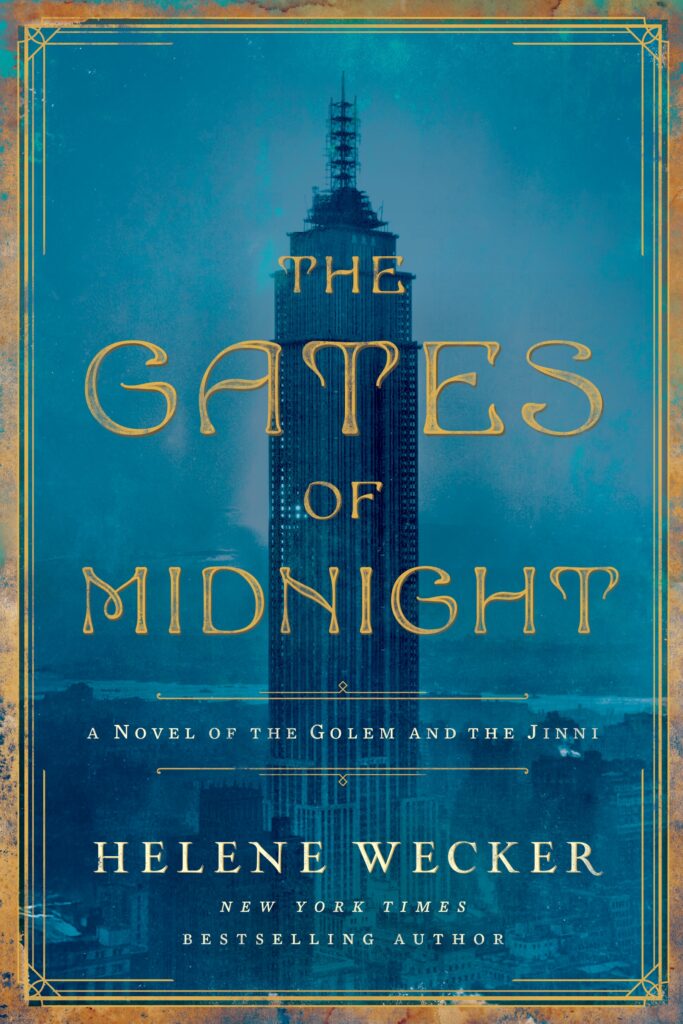
Today marks the release of the final novel in The Golem and the Jinni trilogy by New York Times Bestselling Author, Helene Wecker. In the final novel we rejoin Chava and Ahmad in the 1920s-1930s the era of prohibition, flappers and mob bosses. At this point both Chava and Ahmad have spent years apart, with Chava in Manhattan and Ahmad working as an architect in Chicago.
When a threat arrives in the form of an old foe, they reconnect to fight their common enemy and to protect the lives they have worked so hard to create for themselves in the human world.
In this Q&A we get an inside look into The Gates of Midnight with Author Helene Wecker. She shares about the research process, what it was like saying goodbye to the characters she’s created, and what she’s working on next.

Please tell us what your new novel, The Gates of Midnight, is about (elevator pitch).
The Gates of Midnight is the final volume in the Golem and the Jinni trilogy, which follows Chava the golem and Ahmad the jinni as they arrive in 1900s Manhattan and learn how to navigate the human world. In The Gates of Midnight it’s 1930, and Chava lives in a Brooklyn house where she’s increasingly isolated from others. Ahmad has moved to Chicago, where he works as an architect and tries to fit in with the office culture. But a villain they’d thought long defeated now threatens to rip apart everything they’ve built, so they must come together again, along with an assortment of figures from their past, and reckon once and for all with what it means to live in a world that considers them impossible.
When you began writing The Golem and the Jinni did you know that you were writing a series?
At the very beginning I thought I was only writing a short story! Then, when it became a novel, it was clear there was potential to tell a larger story. I wanted to see how Chava and Ahmad adapted to their situation long term, and how their presence would affect the lives around them. But once I hit three books, I decided to end it there, and let them sail off into the metaphorical sunset.
Did the focus, plot, and journeys of your two main characters Chava and Ahmad, as well as your supporting cast of characters, change as you made your way through the writing process and from book to book?
Chava and Ahmad’s overall journey remained pretty steady from book to book. I knew their dilemma would always be how to pass as human without losing track of their true selves, and how to maintain a relationship with each other despite their differences. But the plot specifics were always up in the air, and it took a lot of trial and error to get them where they needed to go. It was the same for the other characters, too. One of the supporting characters in The Golem and the Jinni is a boy named Matthew Mounsef, and I tried to put him in The Hidden Palace before I realized that the book was completely overstuffed and he just wasn’t necessary. But I was able to bring him back for The Gates of Midnight, where he has a very different fate than I’d originally planned for him!
The trilogy has been praised for blending Jewish and Middle Eastern folklore with American immigrant history. As you wrote this finale, how did you balance honoring that mythology while also pushing the story into new territory and a timely topic that would resonate with new readers?
In one sense, working the mythology into American history has always been the easy part: I just treat it as fact. For the purposes of my books, golems and jinn exist in the world with the rest of us. The difficult part is figuring out the rules and specifics of how they operate, and then keeping it all consistent. What happens if Ahmad gets caught out in the rain? What happens to Chava if she’s trapped in a fire? Since I’d already laid down the foundation in the first two books, for The Gates of Midnight I could bring that “what if” process into 1930 and write scenes like Ahmad’s first airplane ride — would it feel to him like flying used to, back before he was trapped in human form? — and his complaint that Prohibition still applies to him, even though he can’t get drunk! In every era there are new experiences for them to have, and seeing those experiences through Chava and Ahmad’s eyes makes them feel new to me too.
The Golem and the Jinni trilogy has used fantasy to explore the immigrant experience — the longing to belong, the cost of assimilation, the fear of being exposed as something “other.” Do those themes feel different to you now, publishing the finale in 2026, than they did when you began the series?
Writing this series has made me something of an armchair historian, and I’ve never been more conscious of history’s echoes and cycles than when I read about the U.S.’s nativist and isolationist attitudes leading up to 1930. Back then, the demonization of immigrant populations led to severe and explicitly race-based immigration limits in the 1920s. And when Prohibition inevitably led to a huge rise in bootlegging and organized crime, it was the immigrant populations who were blamed. The current rise in antisemitism, Islamophobia, and anti-immigrant sentiment feels very much the same. The details are different, but the attitudes that drive them are universal.
Chava and Ahmad have spent years apart by the time The Gates of Midnight opens, connected only through nightly phone calls. What was it like to write their relationship at this new, more restrained distance?
It was actually a lot of fun to write their telephone calls! I took my inspiration from the times when my husband and I were in a long-distance phase, during our grad school years. I have a lot of nostalgia for those late-night phone calls, when we’d spend hours relating our days to each other and letting the conversations branch off into interesting territory — simply because we didn’t want to hang up and do our coursework!
Critics have praised your “exacting sense of place.” How did you research and inhabit the settings (infrastructure, culture, and more), and events of the early 1900s through 1930s in this new book: New York City, Chicago, the desert, and other settings?
My research process has changed quite a bit over the years. Back when I was researching 1899 for The Golem and the Jinni, it could be difficult at times to find what I needed, and I was glad to have access to Columbia University’s enormous library. But now, so much has been digitized and put online that the problem isn’t finding the information but trying not to drown in it! And fortunately for The Gates of Midnight, the late ’20s and early ’30s were documented extensively in every medium. There was even aerial photography and filming, which helped a lot when it came to the aviation scenes. But the biggest subject I had to research was Prohibition. Before I started, everything I knew about it could probably fit on an index card! I read a number of books about the cultural shifts that led up to Prohibition and then the civic effects afterwards, as well as newspapers from the time, biographies of prominent gangsters, and legal briefs and court proceedings. As always, only a fraction of my research actually made it into the book!
The Golem and the Jinni trilogy has spanned many years of writing and readers’ lives. What does it feel like to finally bring Chava and Ahmad’s story to a close with The Gates of Midnight? Will you miss these wonderful, iconic characters?
I absolutely will miss them, but I also feel it’s time to say goodbye. I can think of them as their own people now, if that makes sense, and send them off to live their lives without my having to guide their every move. My own kids are still too young to leave home, but I imagine this is how it feels to watch them drive away into the distance, that mix of pride and sadness and relief and worry and a sense of “Well, what do I do now?”
What is next for you? Can you tell us what you are working on now?
I have a few ideas but nothing concrete yet! I’m challenging myself to write something completely different, something that won’t require quite the same depth of research. I’d like to write a pure fantasy novel set in a made-up world, just because I’ve never done that before. At this point, I’m ready for a new experience!
About the Author –
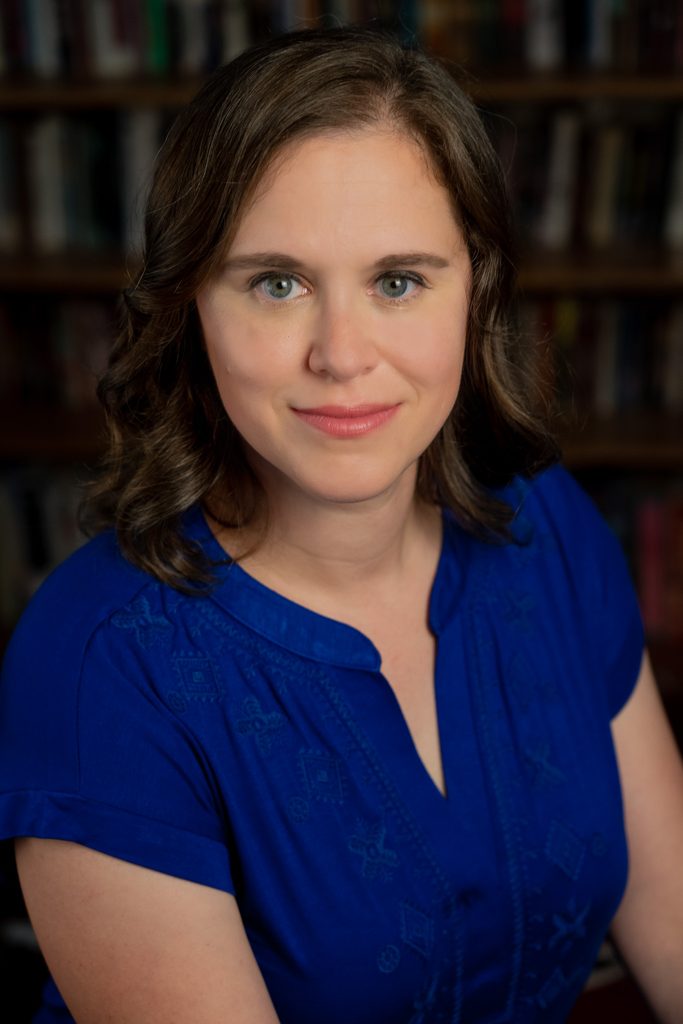
Helene Wecker
Helene Wecker is the author of The Golem and the Jinni—which was awarded the Mythopoeic Award for Adult Literature, the VCU Cabell Award for First Novel, and the Harold U. Ribalow Prize, and was nominated for a Nebula Award and a World Fantasy Award—and its sequel, book two of the trilogy, The Hidden Palace. Her new novel THE GATES OF MIDNIGHT (Harper, 9/15) is the third and final book in the Golem and the Jinni trilogy.A Midwest native, she holds a B.A. in English from Carleton College and an M.F.A. in Fiction Writing from Columbia University. Her work has appeared in literary journals such as Joyland and Catamaran, as well as the fantasy anthology The Djinn Falls in Love and Other Stories. She currently lives in the San Francisco Bay Area with her husband and children.