
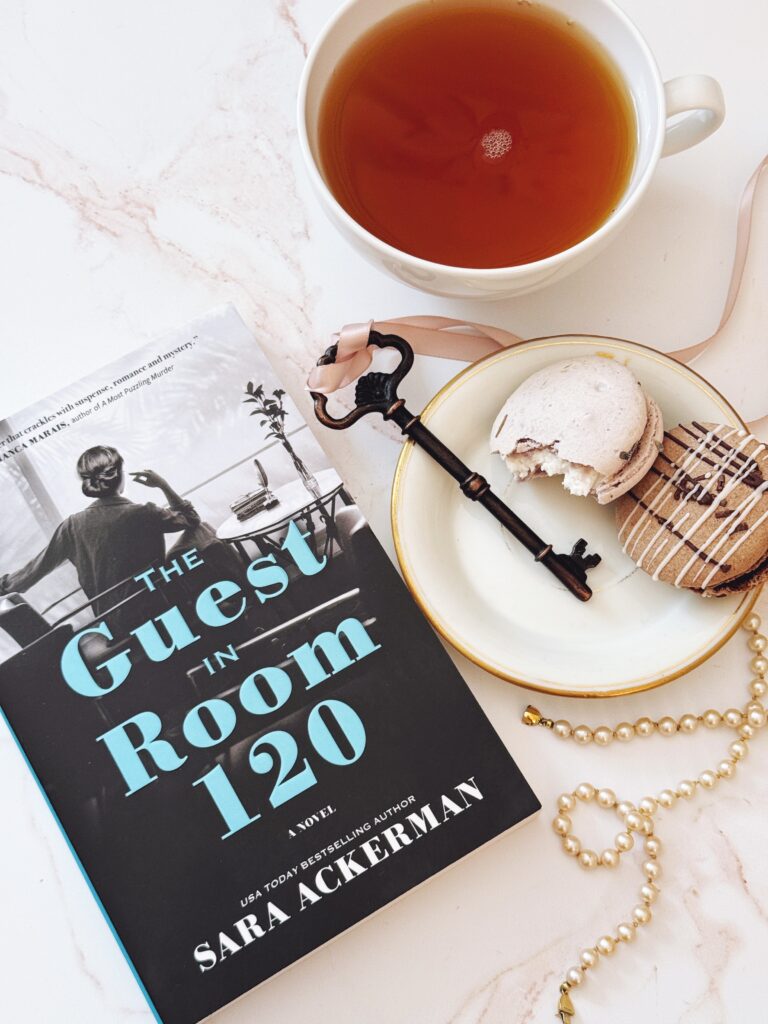
This is the second book I’ve read by Hawai’i-born author Sara Ackerman, after reading last years, The Uncharted Flight of Olivia West, and I enjoyed this dual timeline novel even more. The story is told from the POV of three very different women. Jane Stanford (the co-founder of Stanford University) and Iliahi Baldwin in 1905, and Zoe Finch in 2005, who is dealing with a bit of writer’s block when she attends a writers conference at the Moana. Unknown to her, she is staying in the very same room (120) where Jane stayed 100 years previously.
When notes start appearing under her door, Zoe turns to mystery writer Dylan Winters, one of the speakers at the writers conference. Together, they work to uncover what happened in Room 120 and who was responsible for Jane Stanford meeting her untimely end.
In this Q&A with Sara, she shares about when she was first inspired to write her latest novel (and a sneak peek into her next novel!), her research process, and what it was like writing about the three very different women who inhabit the pages of The Guest in Room 120.

When did you first get the idea to write your latest novel, The Guest in Room 120?
I remember looking up haunted hotels in Hawaiʻi after The Codebreaker’s Secret, because I so enjoyed writing about the Mauna Kea Beach Hotel. There is so much that can happen in a hotel, you know? And in that search, I stumbled upon the story of Jane Stanford’s mysterious death at the Moana. I’ve always had an interest in Stanford University because my father and many of his friends attended school there, so right away, my interest was piqued. The more I learned, the more I knew I had to write this. I also knew I was going to enjoy researching Waikiki in 1905, because I grew up on Oʻahu and spent much of my time between Diamond Head and Waikiki, mostly in the ocean. It took me a while to figure out how to plot the book, adding the 2005 timeline, but that is always the case when I come across a piece of history that I want to write about.
What sort of research into the life of Jane Stanford and her death/murder did you do while preparing to write the book, and what was your most interesting find?
There are numerous books on the subject of Jane’s life and death, so I ordered a bunch of those and read them all cover to cover. There was a lot to digest! Especially the parts about the early years of the university and all of the turmoil and scandals and money troubles. I think the most interesting to me were the Hawaiian newspaper and police accounts of what happened to Jane, and how they were completely ignored by the California police and the Stanford guys. I also listened to an interview with Richard White, retired Stanford Professor who had recently published the book, Who Killed Jane Stanford: A Gilded Age Tale of Murder, Deceit, Spirits and the Birth of a University. He even taught a class where students at Stanford tried to solve the crime, which I found fascinating.
Two of the historical aspects that you included that affected the lives of native Hawaiians. The first being how outsiders tried to keep the traditions of the people who called the islands their home long before they did, from speaking their native language, telling their stories/traditions. The second being how the natives who were afflicted with leprosy were exiled to the settlement at Kalaupapa on Molokaʻi. — What lessons do you hope your readers learn from these hardships the natives of Hawaii have faced during their history?
I felt like I couldn’t set a novel in 1905 Waikiki and not have a local character with a voice in it, and that was where ʻIliahi came in. A fictional young woman who worked at the Moana who was also part Hawaiian, and had been raised by a Hawaiian mother who still honored the culture & traditions that the missionaries tried to squelch. That aspect of the story was consistent with the times, so it arose naturally. The Moana catered to wealthy mainlanders and Europeans, so I wanted more of an insider viewpoint.
As for Kalaupapa, it’s a place and a story that deserves volumes (much has been written, both fiction and non-fiction). ʻIliahi’s family experience is the tragic story of so many people in our islands during those years (roughly 1865-1949) when anyone diagnosed with Hansen’s Disease (then called leprosy) was forcibly isolated on a small peninsula on the island of Moloka’i, the vast majority being Hawaiian. Young ʻIli was forced to be tough and scrappy, but she never lost her incredible spirit. I didn’t originally plan on this part of her history, but it arose as I was researching old Waikiki.
Telling the story through the eyes of three women, Jane Stanford and ʻIliahi Baldwin (via her diary) in 1905, and Zoe Finch (aka Bridget) in 2005, really laid the story out in such an intriguing way. What was it like getting into the ‘headspace’ of three very different women?
Jane was the only ‘real’ main character, and interestingly, hers was the hardest point of view to write. By all accounts, she was a complicated woman. I wanted to show all sides of her, but especially the grieving wife and mother who so desperately tried to contact her deceased husband and son via spiritualism and seances. Yes, she had an iron will and was extremely wealthy and influential, but I think that more than anything, it was the loss that defined her.
It was such a joy to write about Zoe, the author in 2005, because I love writers’ conferences and know them intimately, having been to many over the years. I also love a good love story, so the whole Dylan Winters part made it especially fun.
Even though ʻIliahi’s journal entries are much shorter than Jane and Zoe’s chapters, she really came alive for me on the page. It’s one of my favorite parts of writing–when minor characters actually become way more important than I expect. To set the three apart, I decided I would write Jane’s POV in third person, past tense; Zoe’s POV in third person present tense; and ʻIliahi’s POV (since they are journal entries) in first person, present. I think that made it easier to keep their voices distinct in my head.
Which of the three storylines did you enjoy writing most?
I have to say that I equally enjoyed writing Zoe and ʻIliahi.
Have you stayed at the Moana, where Jane Stanford stayed in the past, and where the writers conference was set in 2005?
Yes I have. But more than that, I spent decades surfing and paddling and hanging out on the beach out front, and walking through the lobby barefoot and in our bikinis when we were kids. I have such fond memories of the ‘good old days’ in Waikiki!
Your novels thus far are set in the Hawaiian Islands. As someone born in Hawaiʻi, what is the most amazing part about sharing different parts of your state’s history with your readers?
I love that I get to share a side of Hawaiʻi that a lot of readers are not familiar with. We have so much history and rich cultural heritage, and are not all coconuts and rainbows, beaches and waterfalls.
While reading the book, I keep wondering what would have happened if Jane had made the trip alone as she’d been advised to. If you could have met Jane Stanford in real life, what would you have asked her?
Right? Oh gosh, that’s a hard one. Because she so adored her son, I might ask: If Leland Jr. had lived, what kind of man do you think he would have become?
Also, because the university meant so much to her, I might ask: When you founded Stanford University in memory of your son, what did you hope it would stand for a hundred years later?
Or maybe: If you could tell the world the truth about your final night, what would you want us to know?
Do you currently have plans for your next novel, and if so, can we get a sneak peek?
My next novel, The Shark House, is actually finished and on NetGalley already! It releases in January and I am SO excited for everyone to read it. It’s about biologist and shark whisperer Minnow Gray, who arrives on the Big Island to investigate a series of deadly shark attacks, but as she descends into the blue Hawaiian depths, she soon learns there is far more going on than meets the eye.